
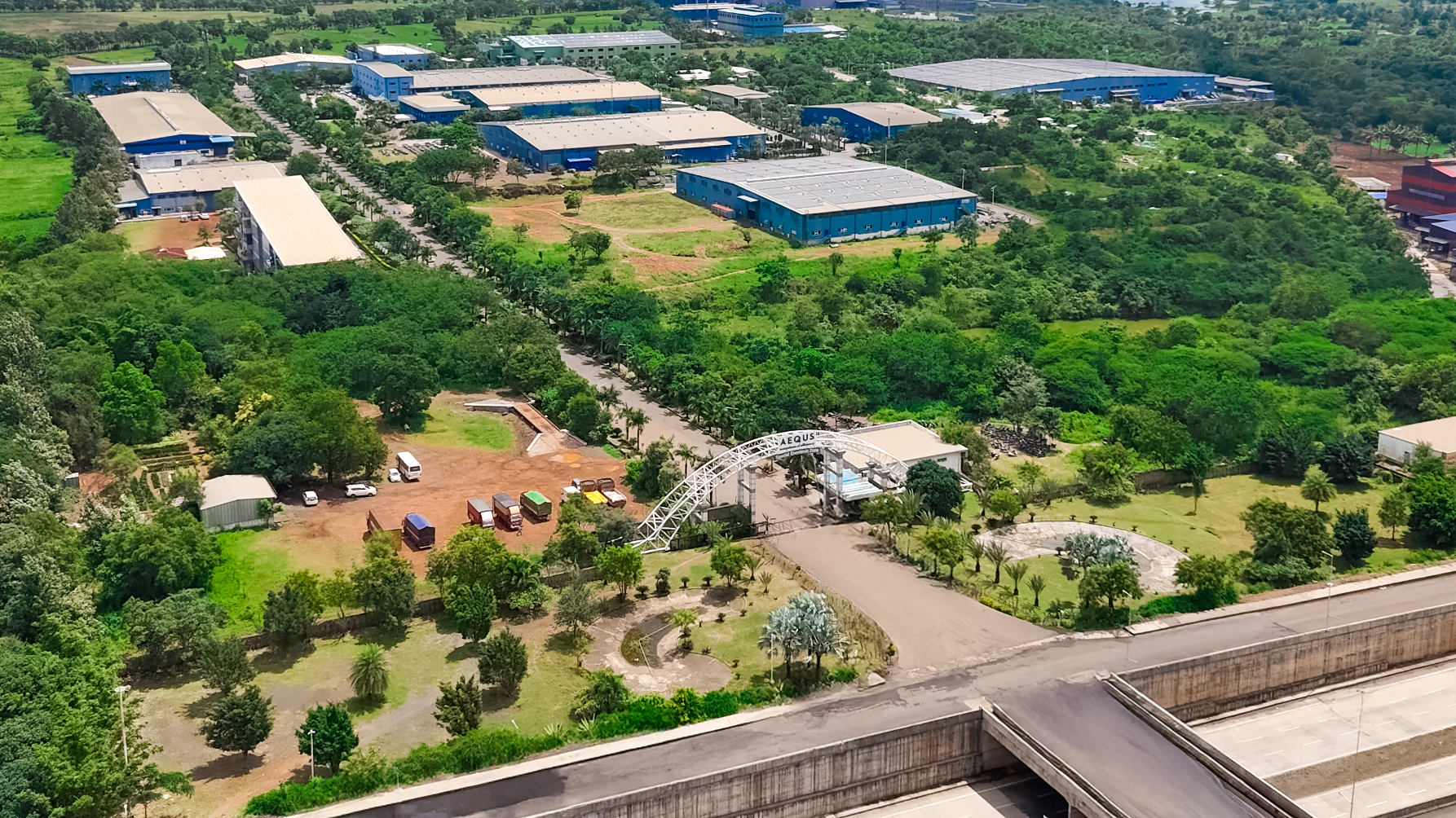
Businesses planning to set up or expand their operations today face a decision that extends beyond selecting a location. It is no longer limited to land and related costs. Businesses must also consider the quality of infrastructure, supplier proximity, availability of talent, the expertise and credibility of the developer, and the operating frameworks that will shape long-term competitiveness.
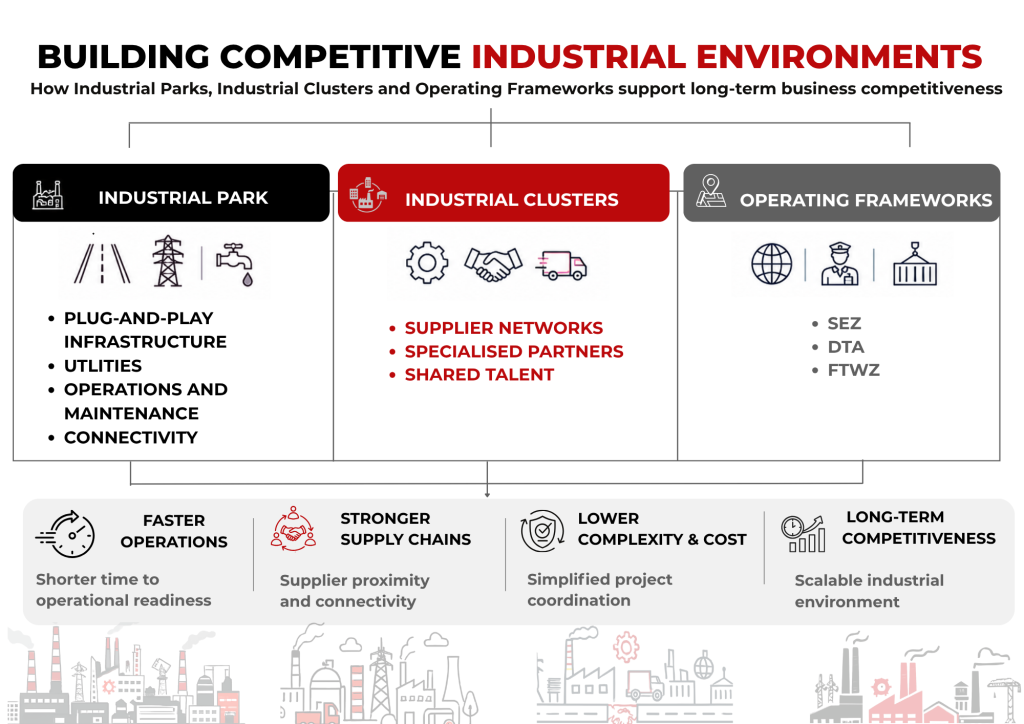
This is where Industrial Parks, Industrial Clusters and Industrial Operating Frameworks, including SEZs, DTAs and FTWZs, become important. Together, they address different aspects of how businesses establish, operate and grow within an industrial environment.
- Industrial Parks provide ready industrial infrastructure that enables manufacturers to establish operations faster while reducing implementation complexity.
- Industrial Clusters bring together OEMs, manufacturers, suppliers, specialised services and service providers, creating efficiencies through proximity, collaboration and shared capabilities.
- Industrial Operating Frameworks such as SEZs, DTAs and FTWZs provide the regulatory environment that supports different manufacturing and trade models.
Together, these building blocks create integrated industrial environments that help businesses move faster from investment decisions to operational readiness, strengthen supply chains and build long-term competitive advantage.
Industrial Parks: Reducing the Distance Between Investment and Operations
For manufacturers, speed is more than an operational advantage. It directly influences project costs, time to market and return on investment. Yet establishing a new facility often begins with land due diligence and can involve time-consuming infrastructure development, utility connections and regulatory approvals, all of which can slow the transition from investment to production.
A well-planned Industrial Park reduces these barriers through a combination of ready infrastructure, operational support and strategic connectivity:
- Strategic connectivity through proximity to national highways, ports, airports and rail hubs, strengthening supply chain efficiency and market access.
- Access to skilled and semi-skilled talent, supporting workforce availability and operational continuity.
- Ready-to-Move and Built-to-Suit facilities, reducing construction timelines and supporting rapid business expansion.
- Plug-and-play infrastructure, including internal roads, power distribution, water supply, drainage and digital connectivity, reducing site development complexity.
- Supporting utilities, including data and telecom, treated water supply, wastewater treatment, 24×7 surveillance, common-area lighting and other essential services, ensuring uninterrupted manufacturing operations.
- Single-window facilitation for faster onboarding, utility connections and statutory and regulatory clearances, simplifying implementation and accelerating project execution.
- Amenities, including canteens, employee transportation, Occupational Health Centres (OHCs), banks and ATMs.
- Professional operations and maintenance (O&M) covering housekeeping of common infrastructure, utilities, roads and shared facilities, 24×7 security and waste management, supporting long-term operational efficiency.
Together, these capabilities enable faster operational readiness, lower implementation risk and greater long-term efficiency.
Industrial Clusters: Where Collaboration Creates Competitive Advantage
Industrial Clusters can strengthen manufacturing competitiveness by bringing suppliers, specialised partners and complementary capabilities closer to manufacturers. Long-term competitiveness depends not only on the infrastructure within which businesses operate in, but also on the strength of the supplier networks and value-chain relationships around them.
A sector-specific cluster brings OEMs, manufacturers, co-located suppliers and specialised partners together, enabling faster problem-solving, shorter lead times and more resilient supply chains. Research from UNU-WIDER identifies supplier proximity, shared labour pools and knowledge spillovers as key drivers of industrial clustering. In practice, being located closer to suppliers and specialised partners can help businesses resolve production issues faster, access relevant skills and share knowledge across the value chain.[i]
This is particularly valuable in sectors such as aerospace, precision engineering, electronics and automotive, where manufacturing relies on tightly integrated supplier networks. OECD research similarly highlights the role of industrial clusters in strengthening productivity and knowledge spillovers through specialised suppliers, skilled workers and geographical proximity. These are also reflected across Aequs’ focus industries, including aerospace, consumer durables, electronics, toys, footwear and textiles, where connected value chains can improve productivity, innovation and responsiveness.[ii]
Industrial Parks provide the broader infrastructure and operating foundation for businesses to establish and scale. Industrial Clusters are designed around the requirements of specific sectors or manufacturing segments, bringing together relevant suppliers, specialised partners and capabilities. They are distinct but complementary, with clusters adding sector-specific value within the broader industrial environment.
Industrial Operating Frameworks: Aligning Infrastructure with Business Strategy
Choosing the right Industrial Park or Industrial Cluster is only part of the decision. Businesses must also consider the operating framework that aligns with how they plan to manufacture, trade and grow. Whether focused on exports, the domestic market or broader international trade, the right operating framework can shape long-term operational efficiency.
Modern Industrial Parks are designed to support different manufacturing models by offering multiple operating frameworks within the same development. SEZs, DTAs and FTWZs support different manufacturing, domestic-market and international trade requirements, allowing businesses to select a framework aligned with their operating strategy.
Rather than treating infrastructure and regulatory requirements as separate decisions, businesses can choose an Industrial Park that brings both together. The result is a more coordinated operating environment designed around how businesses operate and grow.
Putting the Approach into Practice
The value of an integrated industrial environment lies in how well it brings together the conditions a business needs to establish, operate and scale. Aequs Infra develops Industrial Parks that provide the broader infrastructure and operating foundation for businesses, while Industrial Clusters are designed around the requirements of specific sectors or manufacturing segments. An Industrial Park can itself be developed as a cluster or provide the platform for one or more sector-focused clusters. A single point of accountability across the project lifecycle, from concept and commissioning through ongoing operations and maintenance, helps businesses reduce complexity and focus on their core operations. This approach reflects UNIDO’s call to move beyond treating industrial parks primarily as real-estate developments towards infrastructure that supports productivity, sustainability, value-chain linkages and long-term business performance.[iii]
This sector-focused approach is reflected across Aequs’ industrial developments:
- Belagavi Aerospace Cluster: India’s first vertically integrated precision engineering and aerospace manufacturing cluster.
- Hubballi Durables Cluster: India’s first dedicated electronics and consumer durables manufacturing cluster.
- Koppal Manufacturing Cluster: A manufacturing hub designed to support emerging industries through integrated industrial infrastructure and sector-focused manufacturing capabilities.
Building on this, Aequs Infra is expanding into Industrial Parks near Tier I cities including Chennai, Bengaluru and Hosur.
Conclusion
Businesses have always measured manufacturing investments by the efficiency of the factories they build. Increasingly, however, long-term success depends just as much on choosing the right industrial environment around those operations. For businesses planning their next phase of expansion, the decision may no longer be simply where to locate, but which industrial environment will best support their strategy, operations and long-term competitiveness.
Explore Related Resources
Planning a manufacturing expansion?
Explore Aequs Infra’s Industrial Parks and Industrial Clusters to understand how integrated industrial environments can support your business objectives. If you’re evaluating your next expansion location, connect with Aequs Infra to discuss your expansion strategy.
Sources:
[i] UNU-WIDER. Industrial Clusters.
[ii] OECD Policies for improving FDI impacts on productivity and innovation
[iii] United Nations Industrial Development Organization (UNIDO) and DPIIT Country Programme for inclusive and sustainable industrial development