
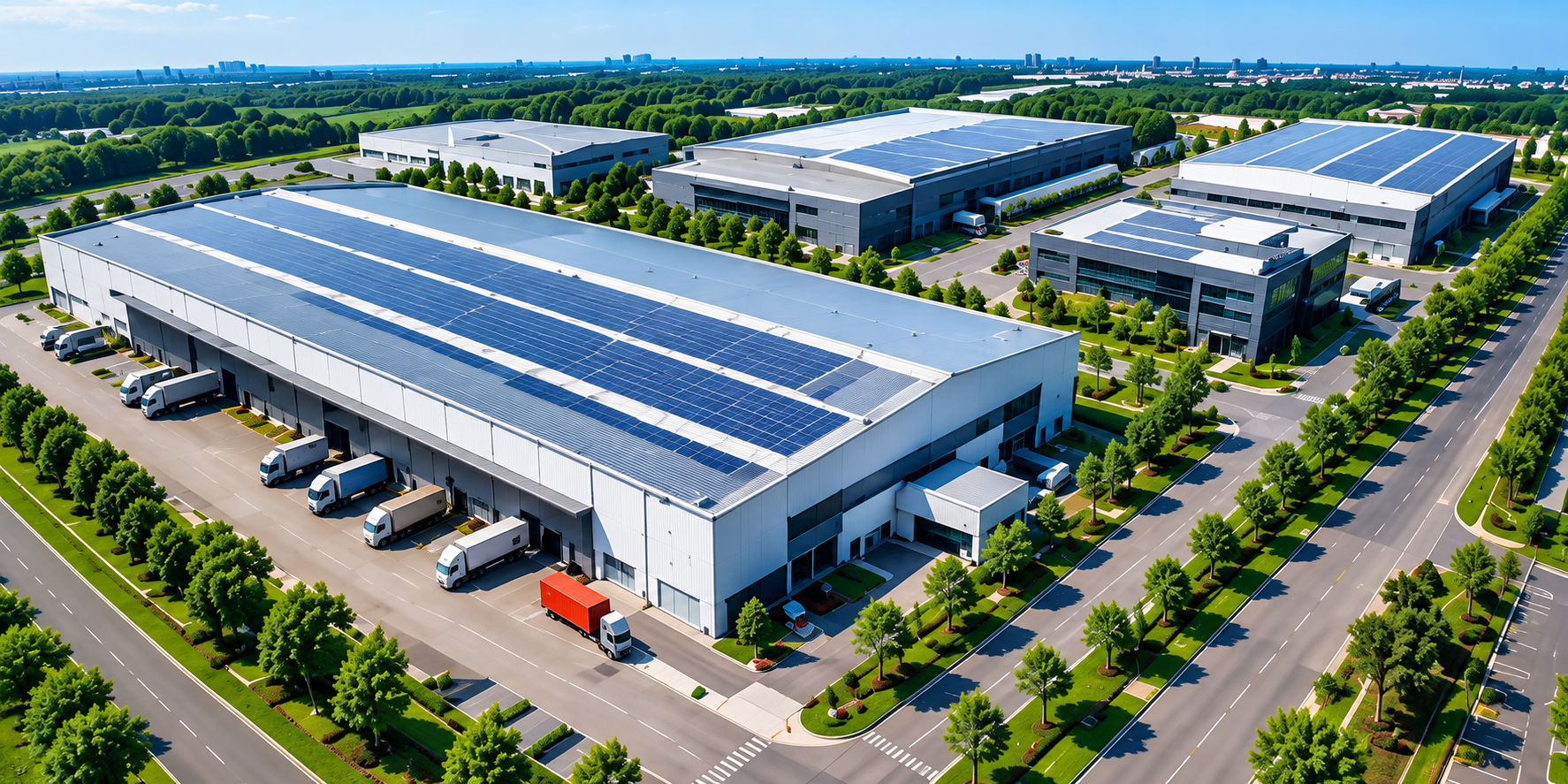
Choosing an Industrial Park is not simply a decision about where to locate a factory. It is a decision about how quickly a business can start, how predictably it can operate, and how easily it can scale. The right park can make that journey simpler by bringing together strategic connectivity, workforce, Plug-and-Play infrastructure, Flexible occupancy formats, utilities, amenities, operations and maintenance, and single-window facilitation support.
Strategic Connectivity
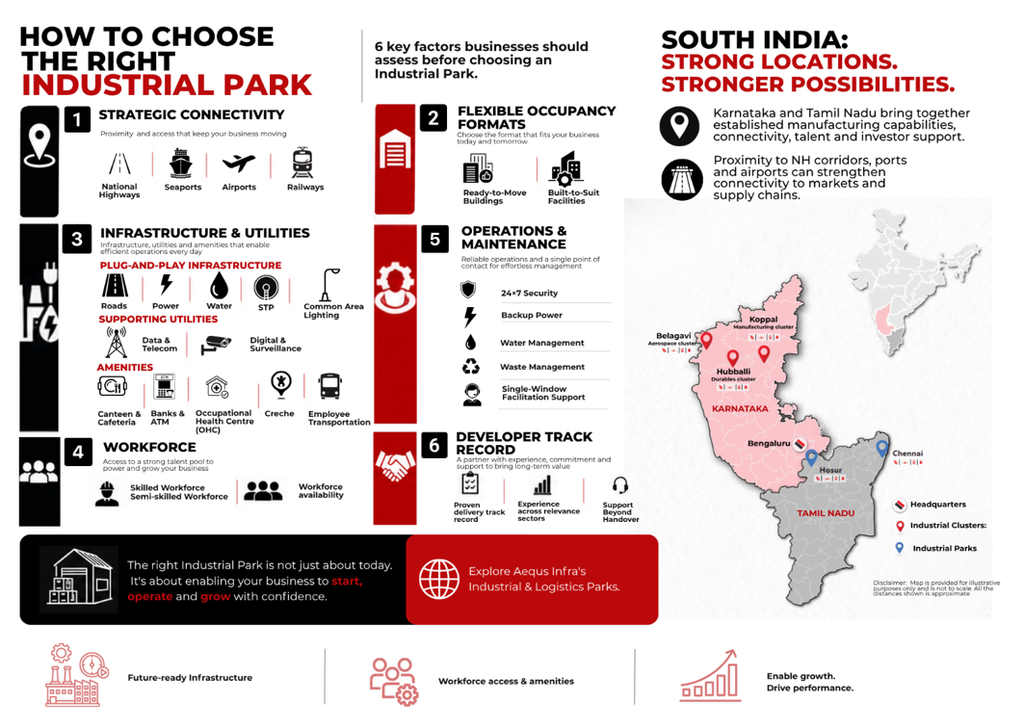
Location matters when choosing an Industrial Park, but proximity alone is not enough. What matters is how well the location connects a business to its suppliers, workforce, customers, and markets. Proximity to national highways, seaports, airports, and railways can reduce logistics friction and improve access to markets, suppliers, and the workforce. Connectivity should therefore be assessed as part of the operating model, not simply as a point on a map.
Flexible Occupancy Formats
The right Industrial Park should offer flexibility in how a business operates and scales. Ready-to-Move (RTM) and Built-to-Suit (BTS) facilities allow businesses to choose a solution that matches their production needs, investment plans, and project timelines.
Infrastructure and Utilities
An Industrial Park’s value is not just in the land it provides but in how much supporting infrastructure is already in place. Plug-and-Play Infrastructure can reduce site preparation time and complexity by providing essential services such as internal roads, power supply, power backup, drinking water, process water, treated water, sewage treatment plant (STP), common area lighting, and solid waste management infrastructure. Businesses should assess how ready the infrastructure is for their specific operational requirements.
Supporting utilities such as security, digital surveillance, data and telecom connectivity, and power backup services can also impact day-to-day operations. Together, Plug-and-Play Infrastructure and reliable supporting utilities can help reduce operational hassles and allow management teams to focus on the business rather than infrastructure-related issues.
Amenities such as canteens, food courts, banks and ATMs, Occupational Health Centres or medical centres, post offices, creches and employee transportation also provide a holistic environment that supports the day-to-day requirements of the workforce and makes an Industrial Park more practical for businesses and employees.
Workforce
Access to talent can be just as important as access to infrastructure. Businesses should consider the availability of trained skilled and semi-skilled workforce in the surrounding areas, particularly where they expect their workforce requirements to grow over time.
Operations & Maintenance
The quality of an Industrial Park is tested long after a business moves in. Day-to-day management of common infrastructure and essential services can directly affect operational continuity and the amount of time management teams spend dealing with non-core issues. Good Operations and Maintenance (O&M) support helps reduce avoidable disruptions and keep companies focused on the business rather than infrastructure. The scope of O&M services covers 24×7 security, backup power, water management, and waste management.
Single Point of Contact
An Industrial Park should provide businesses with a single point of contact for common infrastructure, utilities, and other operational requirements. This can simplify coordination, reduce the need to manage multiple service interfaces, and provide a clearer route for resolving issues that may otherwise require coordination across multiple providers. This can also include single-window facilitation support for licenses, regulatory approvals, and statutory clearances.
Developer’s Track Record
The developer behind an Industrial Park can be as important as the infrastructure itself. Businesses should look beyond the proposed facilities and assess the developer’s track record in delivering industrial parks, experience across relevant sectors, the quality of existing developments, and its ability to support businesses beyond the initial handover.
South India: Karnataka and Tamil Nadu
For businesses evaluating South India, Karnataka and Tamil Nadu offer established industrial bases, access to talent, and proactive government support for new investments. Both states combine established manufacturing capabilities with industrial infrastructure, supported by policies and investor-facilitation mechanisms designed to support new and expanding businesses. Karnataka’s Industrial Policy 2025–30 provides incentives and concessions for eligible investments, while its Single Window System supports approvals and investor services through a unified platform. [i] Tamil Nadu similarly combines an established manufacturing base and industrial corridors with a large industrial workforce, supported by investor-facilitation mechanisms including a Single Window Portal. [ii]
Choosing the right state, however, is only the starting point. The specific location and its strategic connectivity to highways, seaports, airports, railways, talent, and suppliers are equally important.
Aequs Infra’s Industrial Footprint Across South India
Aequs Infra’s current Industrial Clusters in Belagavi, Hubballi, and Koppal are located in Tier II locations and are designed around sector-focused manufacturing requirements. The Belagavi Aerospace Cluster focuses on precision engineering and aerospace; the Hubballi Durables Cluster on electronics and consumer durables; and the Koppal Manufacturing Cluster focuses on supporting emerging industries, including toys, plastics, textiles, apparel, and footwear, through sector-focused manufacturing capabilities. These locations offer connectivity to key highways and regional markets, supporting access to suppliers, customers, and the workforce.
In addition, Aequs Infra’s upcoming Industrial Parks near Bengaluru, Hosur, and Chennai will extend the footprint into Tier I industrial locations across South India.
Conclusion: Match the Park Offering to the Business
The right Industrial Park brings together the infrastructure, connectivity, and operating environment a business needs today, while giving it room to grow tomorrow.
For businesses planning their next expansion, the right Industrial Park should make it easier to get started, operate efficiently, and grow with confidence.
Want to explore your options? Discover Aequs Infra’s Industrial and Logistics Parks.
[i] Government of Karnataka, Industrial Policy 2025–30 and Invest Karnataka, Single Window System
[ii] Government of Tamil Nadu, Tamil Nadu Industrial Policy 2021 and Tamil Nadu Single Window Portal.