
Choosing an Industrial Park is often seen as a decision about location, land and cost. But the bigger question begins after the location has been chosen: How quickly can I start? How reliably can I operate? And how easily can I scale?
A business needs more than a site to operate. It needs connectivity, infrastructure, utilities, talent and the services that keep the business running. The right Industrial Park brings these elements together, making it easier for a business to get started, operate and grow.
The decision, then, is not simply about finding a site. It is about choosing how easily your business can operate once you get there.
Start with the business, not the site
Before evaluating an Industrial Park, businesses should consider what they need to operate. Is it well connected to suppliers, customers and markets? Is the infrastructure ready? Can workforce requirements be met as the business grows? Are utilities and essential services reliable? And who is responsible for keeping the common infrastructure running?
These questions shift the decision from “Which Park has the right land?” to “Which Park can best support the way my business needs to operate and grow?”
Strategic Connectivity
Location matters. Connectivity matters more. Proximity alone does not make an Industrial Park strategically located. What matters is how effectively the location connects the business to its suppliers, workforce, customers and markets.
Access to national highways, airports, railways, and seaports can help reduce logistics friction and improve the movement of people and goods. For a business, the question is not simply, “Where is the Industrial Park?” It is, “How well does this location connect my business to the ecosystem it depends on?”
Connectivity is part of the operating model, not just a point on a map.
Flexible Occupancy Formats
The right space should fit the business, not the other way around. Businesses do not all start or grow at the same pace. Some need to begin operations quickly; others may need facilities designed around specific operational requirements or plans to expand.
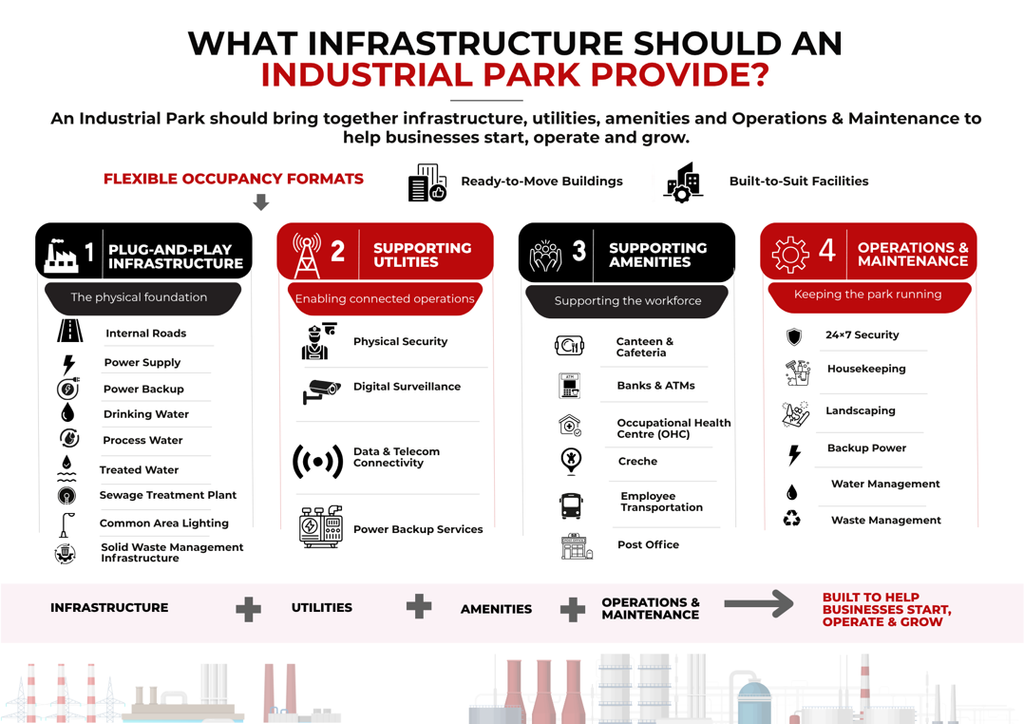
Flexible Occupancy Formats such as Ready-to-Move (RTM) and Built-to-Suit (BTS) facilities give businesses options aligned with their needs, investment plans and timelines.
The point is not simply to offer more choices. It is to give businesses the flexibility to choose a format that works for them today and supports where they want to go tomorrow.
Plug-and-Play Infrastructure
Infrastructure should make getting started easier. For a business, land is only the beginning. The real question is how much of the supporting infrastructure is already in place and ready to align with its operational requirements.
Plug-and-Play Infrastructure can reduce site-preparation time and complexity by providing essential systems such as internal roads, power supply and backup, drinking and process water, treated water, sewage treatment, common-area lighting, solid waste management infrastructure, etc.
But the value is not in the list itself. It is in what that readiness means for the customer.
Supporting Utilities
Infrastructure helps you get started. Supporting utilities help keep day-to-day operations running. Physical Security and Digital Surveillance can help protect people, assets and common areas. Data & Telecom Connectivity supports communication and coordination across facilities, while Power Backup helps reduce the impact of power interruptions on day-to-day operations.
Together, these services reduce the number of basic systems a business needs to arrange and manage on its own.
The benefit is straightforward: the more reliably these services work, the fewer times the business needs to intervene. This allows management teams to focus on the business, customers and growth rather than everyday infrastructure issues.
Workforce & Supporting Amenities
An Industrial Park may be built around infrastructure, but businesses are built around talent. Access to a skilled and semi-skilled workforce is an important consideration when evaluating a Park. Businesses should look not only at talent availability today, but also at whether the surrounding area can support their workforce requirements as they grow.
What surrounds the workplace matters too. Supporting amenities such as Occupational Health Centres, canteens and cafeterias, creches, employee transportation, banks and ATMs can make everyday working life more practical. These may not be the first things a business considers when evaluating a site, but they can make a real difference to the employee experience and a company’s ability to attract and retain its workforce.
Operations & Maintenance
Readiness should continue after you move in. An Industrial Park’s value is tested every day after a facility becomes operational. Common infrastructure and essential services need to be maintained consistently to keep operations running.
Operations and Maintenance (O&M) covers the day-to-day management of common infrastructure and essential services. This includes 24 × 7 security, housekeeping, landscaping, backup power, water management and waste management.
For businesses, the question is not only what is provided, but also: Who is responsible for keeping it working?
When the Industrial Park developer or operator takes clear responsibility for common infrastructure and services, it can reduce avoidable disruptions, and the time management teams spend dealing with non-core infrastructure issues. Good O&M should work in the background, keeping essential services running while the business stays focused on its operations.
The real value is in what the business doesn’t have to manage
An Industrial Park can offer excellent infrastructure. But its real value comes from how much it takes off the customer’s plate.
Connectivity, Flexible Occupancy Formats, Plug-and-Play Infrastructure, utilities, amenities and Operations & Maintenance each have a role. Together, they reduce what a business has to manage on its own. And that matters because every business has enough to focus on customers, people and growth.
The best infrastructure is often the infrastructure that works reliably in the background, without demanding the business’s attention.
From Infrastructure to Business Readiness
This is the thinking behind Aequs Infra’s Industrial Parks and Industrial Clusters.
Its Industrial Clusters in Belagavi, Hubballi and Koppal are built around sector-specific manufacturing requirements, with infrastructure and supporting services designed for businesses operating in these locations. The upcoming Industrial Parks near Bengaluru, Hosur and Chennai take the same approach into Tier I industrial locations across South India.
The idea is simple: an Industrial Park should help a business move from setting up to operating and, eventually, scaling, without having to build every piece of supporting infrastructure itself. That is what makes the difference between simply having a site and having a business-ready Industrial Park.
Choose more than a location.
Choosing an Industrial Park is not just about finding a suitable site. It is about finding the right conditions to start, operate and grow.
The evaluation should go beyond: “What infrastructure does the park provide?” A better question is: “How much will the park simplify the way my business operates?”
When the essentials work well in the background, the business can focus on what matters, serving customers and growing.
Want to explore your options? Discover Aequs Infra’s Industrial Parks and Industrial Clusters.